
A Cosmic Disconnect
When we first started reviewing board games, we couldn’t have told you what separated a seven from an eight. Vibes?! We had our reasons, obviously, but how much of that number came from the gameplay, and how much came from being distracted by pretty artwork and a theme we happened to like? Hard to say. It’s part of why we eventually developed our own rating system, with categories, a scoring legend, and criteria tailored to what matters to each of us. We’re still biased, of course, but at least now we have to put a little more thought into justifying our numbers.
Unfortunately, there’s still a flaw in this whole attempt at objectivity: we can only rate the games we actually play. And while we’ve gotten better at separating our personal tastes from the quality of a game, those same tastes still have a pretty significant say in what makes it off the shelf (or even onto the shelf) in the first place. Preach about gameplay being king all you want, but if the box doesn’t catch our eye or a theme sounds as exciting as doing our taxes, how often are we really giving those mechanics a chance?
Which brings me to space. An entire universe of possibilities, and somehow I keep seeing the same six planets in different colours.
A ridiculous oversimplification? Probably. But there’s only so much excitement I can muster for another metallic spaceship, futuristic control panel, or glowing ball floating against a black background. Throw some rings around it, change the lighting, add a nebula if you’re feeling particularly adventurous… lovely. Another planet! And I’m not saying the artwork is bad, either; some of it is genuinely impressive. I just don’t find much of it appealing, Duncan’s in the same boat. Apparently, our imagination has its limits when it comes to glowing orbs of various hues.
Maybe it’s because space itself feels so far removed from anything we can actually relate to? Looking up at the sky at night, it’s easy to limit yourself to seeing darkness with a few twinkles scattered around. Obviously there’s an extraordinary amount happening beyond what we can see, but we’re not often lying awake wondering what’s going on out there. Most of what we know about distant galaxies and celestial bodies comes from textbooks, photos, movies, and someone much smarter than us explaining things we’ll probably never experience firsthand. And for the record, we believe in space; we’re just not particularly enthused about spending our Saturday evening pretending to manage it all.
Perhaps that unfamiliarity is what makes the theme feel so abstract. Ask us to build a railway network, till a farm, or knit a sweater for a cat, and we can immediately picture what we’re working toward. I’ve seen trains, I grew up on a farm, cats need to stay warm! But ask us to create an entire solar system and suddenly we’re collecting unfamiliar resources to upgrade celestial bodies whose significance we mostly understand because the rulebook told us so. It’s a much grander undertaking, apparently, but we’re not convinced that makes it any more satisfying.
So either we’re obtuse, or space just isn’t doing much for us. Of course our dislike doesn’t mean space games can’t be excellent, and we’ve both enjoyed plenty of games with themes we wouldn’t normally give a second glance. But when neither the setting nor the artwork is doing much to pull us in, something else has to make up the difference.
Entropy had a few things working in its favour: a Board & Dice release, Simone Luciani’s name on the box, and a review copy that arrived shortly after our honeymoon when we were itching to get back into board games. Had the circumstances been different, I suspect it would’ve spent considerably longer sitting on our shelf.


The Real Space Jam
Gameplay Overview
In Entropy, you’re competing to develop solar systems, populate planets with life, and pursue objectives that will hopefully leave you with more points than everyone else. You’ll create and evolve stars, collect planets, introduce bacteria, plants, and animals, and gradually improve the abilities that make your little corner of the universe function. All while one scientist wanders around a circular board, apparently responsible for an entire cosmic development project. Staffing seems a little optimistic.
That scientist is your worker, and almost everything you do begins with moving them around a rondel. There are six sections, each offering a choice between an inner and outer action. The inner ring contains three major actions, each appearing twice, while the outer ring offers six different supporting actions.
So, nine unique actions in total. Manageable, right?


On your turn, move your scientist one to three sections clockwise, choose either the inner or outer action at your destination, and collect a traffic bonus based on how far you travelled. The fewer steps you take, the better the bonus. Naturally, my immediate instinct was to move one space at a time, collect absolutely everything I could, and eventually arrive wherever I needed to be. Why skip free stuff?
Well, for starters, Duncan.
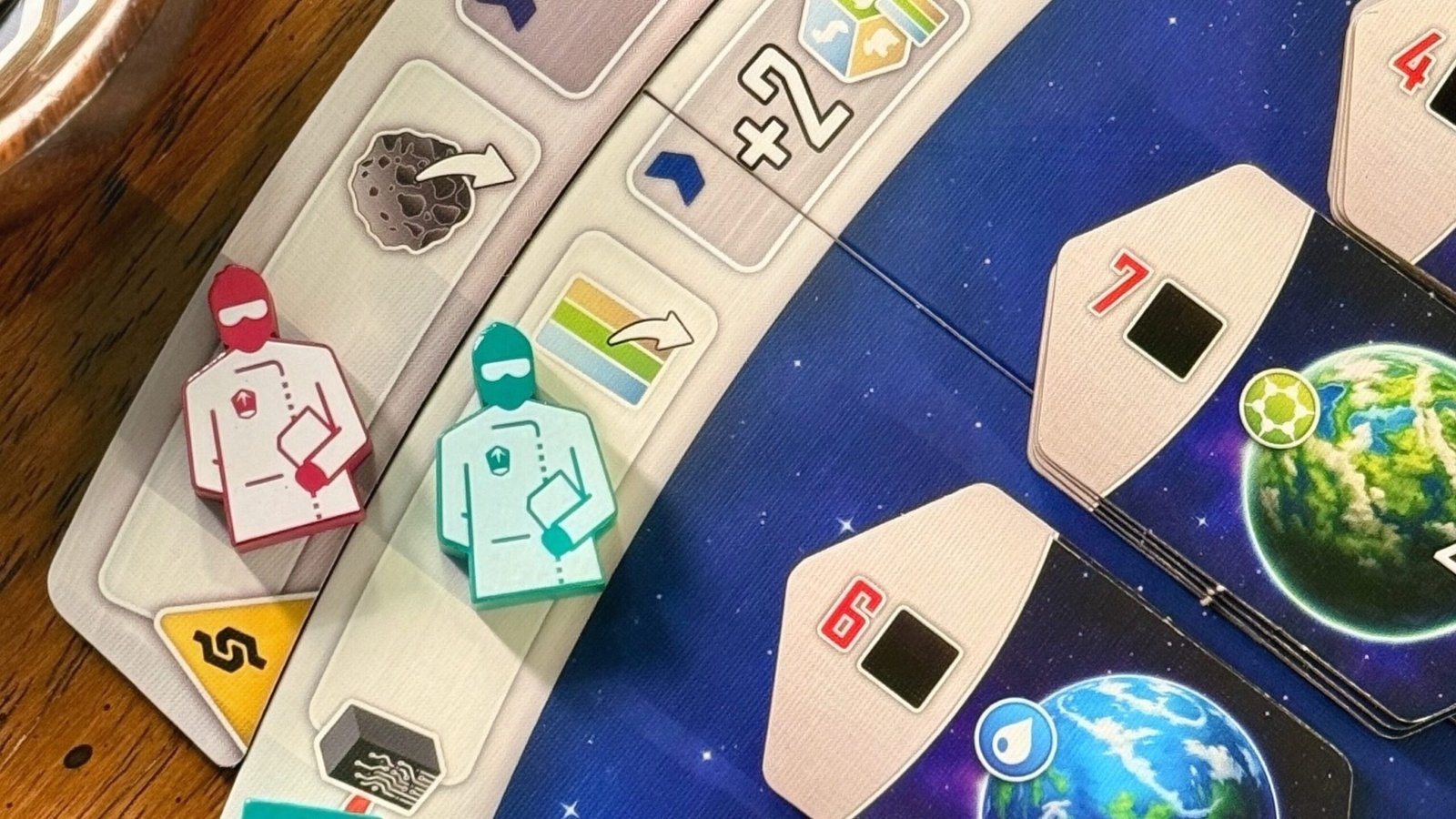
Landing where another scientist is already standing reduces your traffic bonus, effectively counting that occupied space as an additional step. And at two players, even choosing opposite rings of the same section counts as sharing a space, whereas at higher player counts those positions are treated separately. It’s a clever way to keep players getting in each other’s way, even at two. Unfortunately, it also meant Duncan and I spent half our time in a game of cat and mouse, chasing each other around a circle.
But other players aren’t the only reason to pick up the pace. Entropy also has a rather effective way of stopping you from repeatedly taking whichever action happens to be most useful.

You start with three Creation tokens, one for each major action. To perform an inner-ring action, you must place its matching token beside that space, leaving it there until you travel past it again. While it’s stranded on the board, you can’t repeat that action, even if you reach its identical counterpart on the opposite side. Passing your token lets you retrieve it, with an additional benefit of gaining entropy or activating a star. You can eventually unlock a wild Creation token for some extra flexibility, but you still have to work within the same movement restrictions.
Now that lovely one-space traffic bonus doesn’t seem quite so generous. Moving slowly gives you more resources, but it also takes longer to recover the tokens you need to keep developing your solar systems. Moving quickly gets you back into action, but you sacrifice bonuses and skip opportunities along the way.
And this is where Entropy started winning us over. You’re not simply deciding which action is best; you’re figuring out which sequence of actions gets you what you need without spending half the game collecting things that were only marginally useful in the first place. Sometimes moving three spaces for a mediocre bonus is the smartest thing you can do, particularly if it means recovering a Creation token and setting yourself up for something considerably better next turn.
A Universe of Moving Parts
The Inner Circle
So what exactly are these nine actions we’re making such a fuss about?

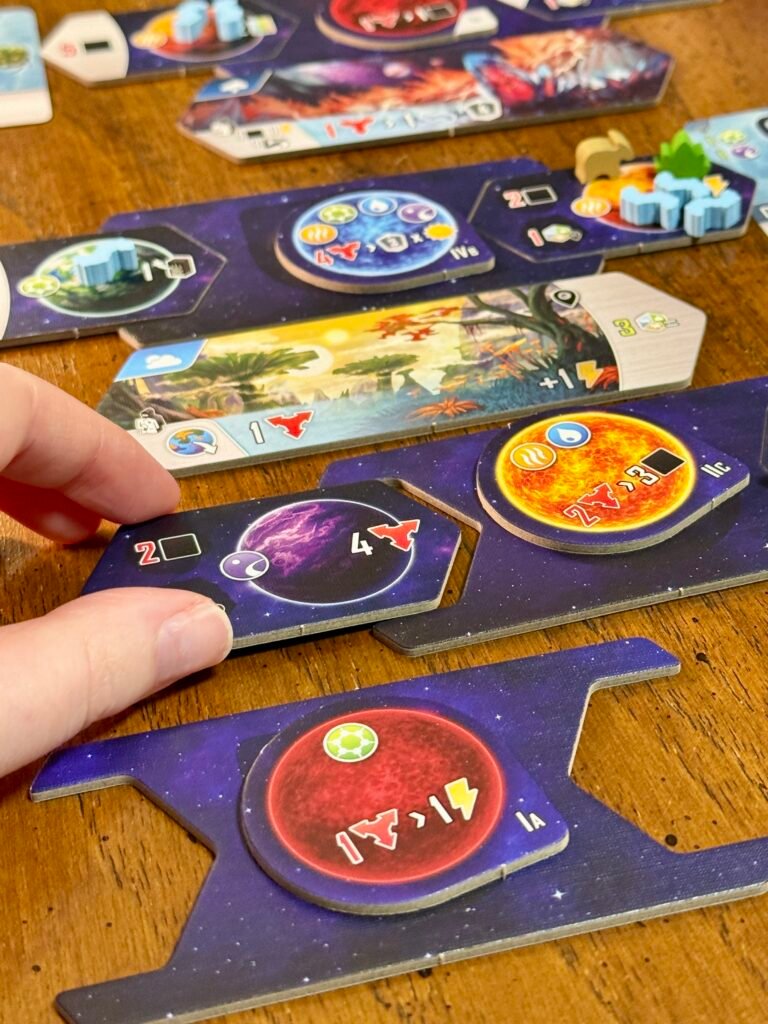
The three inner actions handle most of your cosmic construction. Evolve a Star lets you purchase a new star or improve one you’ve already built, using energy to develop increasingly powerful versions. Stars provide symbols and abilities, beginning with fairly modest resource conversions before developing into more useful effects. Each solar system accommodates one star and up to two planets, so expanding your collection gives you more places to develop life, while upgrading existing stars can make the systems you’ve already built considerably more productive.
Aggregate a Planet uses mass to add a planet to an existing solar system or establish a new one. Planets come with their own symbols, or tags, and abilities that activate when acquired and can sometimes be triggered again later. If you’ve played Terraforming Mars, the idea of collecting the right tags to satisfy card requirements will feel familiar.

And those tags are important because your third major action, Create Life, is how you’ll populate those planets with bacteria, plants, and animals. Not quite as scandalous as the name initially suggests.
You’ll play Life cards onto compatible planets, using the symbols provided by the planet, its star, and any attached asteroids to meet the requirements. You can also supplement a single requirement by discarding a card from your hand. The cards introduce lifeforms and award additional effects, but they can also require spending lifeforms you’ve already collected. Apparently, the circle of life involves quite a lot of accounting.
Already, the decisions start feeding into one another. Do you buy a planet because it complements the star you’ve upgraded, or upgrade a star to accommodate the cards
you’re holding? Would another solar system give you more flexibility, or are you better off improving the one you’ve already invested in? And if you’re missing a single symbol, is it worth spending an entire major action developing something new when a smaller action might solve the problem?
The Outer Circle
Which brings us to the outer ring, where the supposedly minor actions start making a rather convincing case for themselves.
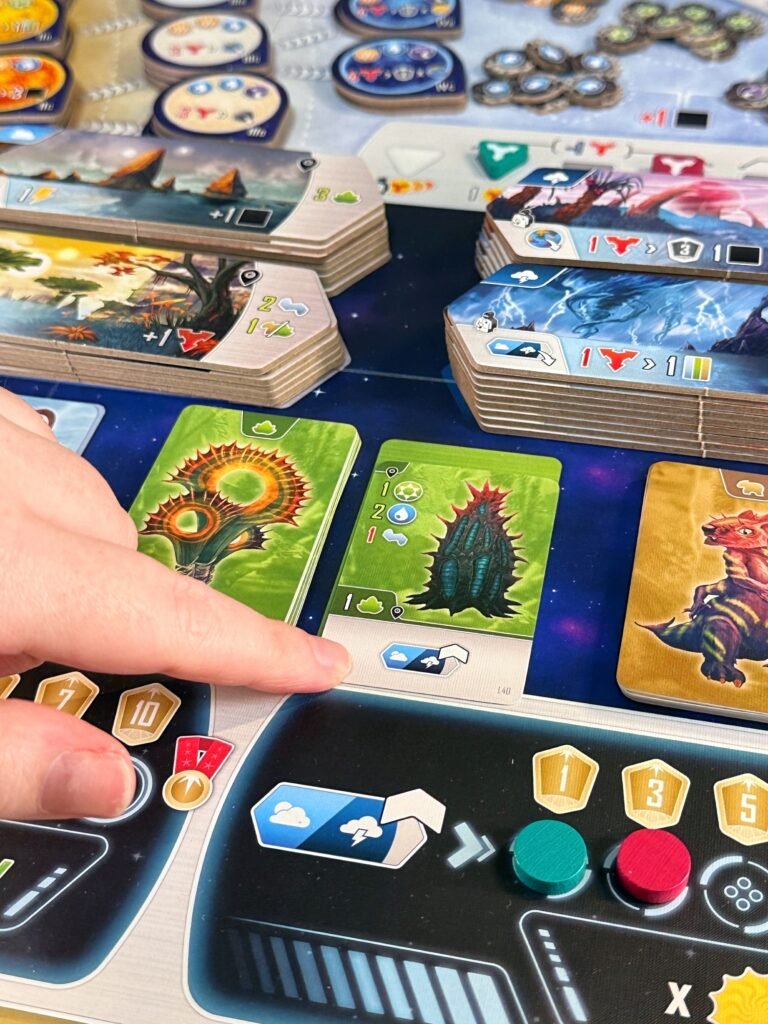
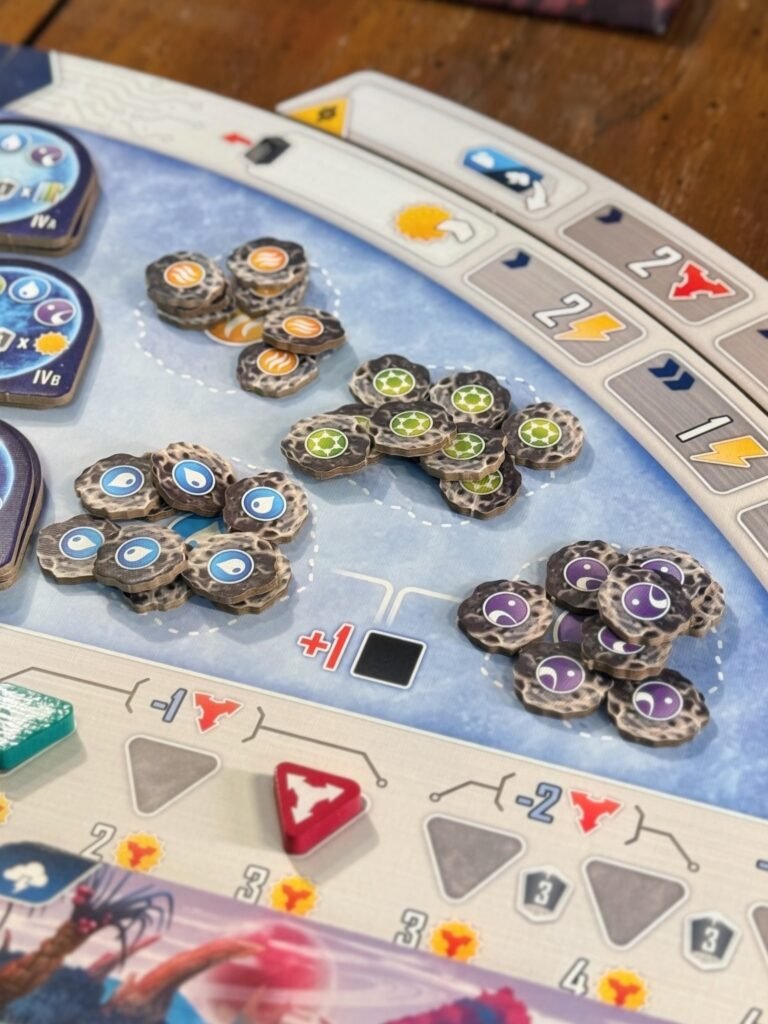
Take Life Cards is straightforward enough: gain the cards you’ll eventually play onto your planets. Early on, bacteria cards tend to be easier to accommodate, while more advanced lifeforms demand combinations that take a little more preparation. You can build toward the cards you’ve collected or collect cards that suit what you’ve already built, although the market doesn’t always share your enthusiasm for either plan.
Catch an Asteroid lets you attach an additional symbol to a planet, usually at a cost, while triggering that planet’s ability again. It’s a handy way to satisfy a missing requirement without rebuilding half your solar system, and occasionally the bonus you trigger is worth the detour on its own.

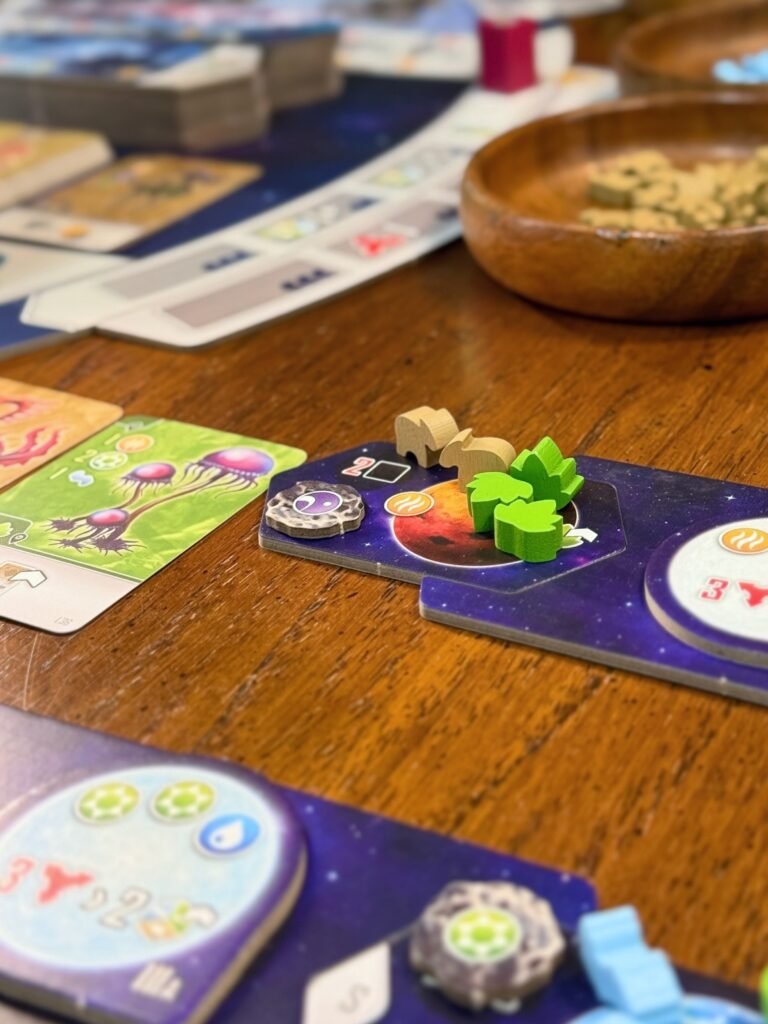
Activate Stars allows you to spend entropy to use the abilities of stars in your tableau. You can activate multiple stars, each once per turn, provided you can afford them. As those stars evolve, their effects become more attractive, but their costs can also increase. Improving your Generator track reduces those costs for a number of activations, which means even the efficiency of your engine has its own little engine to maintain.
Then there’s Primordial Soup, easily the best-named action for something that sounds suspiciously like collecting leftovers. It helps advance your Generator and gather resources, while its traffic bonus can also let you develop lifeforms, introducing bacteria or upgrading existing life into plants and animals. Not necessarily the most glamorous stop on the rondel, but sometimes exactly what your plans need.
The last two actions are where things can get a little combo-y.


Set a Biome lets you attach a biome to a planet, giving you an ongoing bonus associated with a particular action. Meet the biome’s lifeform requirements and you can upgrade it for a stronger effect. Suddenly, taking an action on the rondel doesn’t just give you that action and its traffic bonus; it might also trigger a biome you’ve developed specifically to make that stop more rewarding.
Upgrade Your Console works similarly, except this time you’re improving the three major actions themselves. Beneath your Creation tokens are Focus cards with three levels of abilities, allowing you to unlock additional benefits whenever you use the corresponding action. Different players receive different sets, introducing a little asymmetry and giving everyone their own opportunities to exploit.
And that’s the rondel! Nine actions, nothing too outrageous. Except now your star can provide a resource, your planet can trigger another effect, your biome rewards you for taking a particular action, your Focus card adds something extra, and the traffic bonus might give you precisely what you need to activate something else. One seemingly ordinary decision can become a small chain of rewards, provided you’ve built the right pieces around it…
A Chain Reaction
The Satisfaction of Doing More with Less, and Knowing When Enough’s Enough
We love this kind of engine building, especially when you can gradually make actions more productive without having to work any harder to take them. There are few things more satisfying than realizing an action you were going to take anyway now comes with three additional benefits, or that you’ve found a way to accomplish something indirectly without spending another precious turn travelling to its designated space.

And because your Focus cards, available biomes, and developing solar systems can differ, there’s room to build an engine that suits the opportunities you’ve been given. You might lean into star activations and Generator efficiency, focus on making your major actions more rewarding, or develop biomes that turn frequently visited spaces into particularly profitable stops.
The trick is getting those pieces to cooperate before you’ve spent so much time preparing that there’s nothing left to prepare for.
Our first game was a good demonstration of how easily you can lose the plot. We spent an unreasonable amount of attention on bacteria, then started branching into everything else because, well, everything looked useful. And to be fair, most of it was! The problem was that we were collecting benefits without always considering whether they supported what we were actually trying to score.
Entropy gives you plenty of ways to become more efficient, but efficiency and points aren’t necessarily the same thing.

A Race Against Space and Time (But How Coordinated Are You?)
Chasing Milestones and Managing Multipliers
Alongside points earned throughout the game, there are three public end-game scoring conditions. Each has a multiplier that you improve through certain achievements, but the thing you’re doing to increase that multiplier isn’t necessarily the thing you’ll eventually be scoring.
Here, maybe an example will help. Take the starting objective involving planets of matching colours. Collecting planets of the same colour contributes to your score, but improving the corresponding multiplier requires developing stars to higher levels. You can have an impressive collection of matching planets and a miserable multiplier, or spend ages upgrading stars only to discover you haven’t collected enough planets to make the investment worthwhile.
So now you’re trying to coordinate two different areas of development for one scoring opportunity, while the other objectives are asking you to do something else entirely. It’s not enough to have a productive engine; you need one that’s productive in the right directions.
And there are MULTIPLE directions!
That was probably our biggest lesson from the first play. Trying to do a little of everything feels sensible because so many actions feed into one another, but spreading yourself too thin can leave you with a wonderfully versatile collection of abilities and very little to show for it on the scoreboard. There’s value in identifying a few objectives worth pursuing and making your engine serve those goals, rather than collecting every bonus that happens to be within reach.
Of course, you can’t completely ignore the other scoring opportunities either, because Entropy has another rather inconvenient feature: a race.

Public milestones reward players for reaching certain quantities of bacteria, plants, and animals, with more valuable rewards available to those who get there first. And remember how playing Life cards can require spending existing lifeforms? That means building toward a milestone isn’t always a steady climb. You might be sitting just below the required number, spend a few lifeforms to play a useful card, and suddenly find yourself several steps further away.
We learned that sometimes the best opportunity is the one you take immediately, even if the action itself isn’t especially impressive. Holding out for a more efficient turn sounds wonderful until Duncan claims the milestone you’ve been working toward and you’re left congratulating yourself on all the resources you saved.
This also changes how closely you need to watch your opponents. Most of the game feels like you’re building your own little universe, with everyone else largely minding their business. Nobody is dismantling your solar systems or interfering directly with your upgrades. But you absolutely need to know who’s approaching a milestone, who’s developing their scoring multipliers, and whether the scientist blocking your preferred rondel space is about to ruin more than just your traffic bonus.
It’s a weird mix of multiplayer solitaire and indirect competition. You’re mostly concerned with your own game, but the people sitting across from you still have a considerable say in how smoothly it operates.
All The Time in the World (Until You Don’t)
The Unpredictable Endgame and the Pressure to Make Every Turn Count
And here’s where Entropy pulls off what might be my favourite trick.
There isn’t a fixed number of turns.
For people who regularly finish a Euro wishing we could have just one more action, that sounds delightful. We could develop our stars, improve our consoles, build out some biomes, get everything working together, and eventually start turning all that effort into points! No arbitrary ten-round limit hanging over our heads. Wonderful!

Except there is a limit. The game just doesn’t tell you exactly when it’s coming.
Six achievements around the board can trigger the endgame: three tied to the highest lifeform milestones, and three associated with reaching the ends of the scoring-multiplier tracks through developments involving stars, asteroids, and biomes. Once any two have been triggered, everyone finishes the current round and gets one final turn.
One.
After all that time building an engine, collecting resources, improving abilities, and arranging the perfect sequence of actions, someone reaches a milestone and suddenly the universe is closing for business.
And that’s what makes the rondel so much more interesting than it first appears. The game gives you the impression that you have all the time in the world, then makes you compete against people who are quietly deciding how much time you actually have.

Early on, taking one step and enjoying the extra resources feels almost irresistible. Later, when two milestones are dangerously close to completion, those same bonuses start looking like a luxury you can’t afford. You might need to move three spaces, skip something useful, recover a Creation token, and get to a scoring opportunity before somebody else decides the game is over.
As habitual maximizers, we’re also guilty of avoiding milestones when possible because we’d rather squeeze another few turns out of our engines. Unfortunately, that only works when everyone else is equally committed to postponing the inevitable. You can spend an entire game preparing for a spectacular finish, only to discover that somebody else has already scheduled it.
And I love that pressure.
Not because I enjoy having my plans ruined—although apparently I’ve developed quite a tolerance for it—but because it makes timing matter as much as the actions themselves. You can’t simply ask whether an upgrade is good, you have to ask whether there’s enough game left for it to be good. Is that extra star activation worth the turns needed to develop it? Should you chase another multiplier or secure the points you’ve already prepared? Would you rather take a weaker action now or risk never getting the stronger one at all?
Entropy doesn’t necessarily end quickly, but it can end suddenly. There’s a difference. You might spend two hours building something increasingly elaborate, then realize you have precisely one turn left to do all the things you were convinced you’d eventually get around to.
That feeling of never quite doing enough is something I genuinely enjoy in a strategy game (Duncan, not so much; he likes to be the one in control of the sudden ending). But I don’t need to accomplish everything; I want the decisions about what to leave unfinished to be difficult! And Entropy is good at making several options look worthwhile while ensuring you can’t pursue all of them efficiently.
Even God Needed a Rest Day, Right?
Managing Complexity, Navigating the Learning Curve, and Keeping Everything Running
The downside is that all those decisions can become exhausting, especially while you’re still learning how the systems fit together.
The nine actions themselves aren’t terribly complicated. The challenge is remembering what you’ve attached to them. Which Focus ability have you unlocked? Does a biome trigger here? Can you activate a star afterward? Did that planet effect give you another resource? Does spending those lifeforms ruin your milestone progress?

ThinkerThemer really couldn’t have put it better. At times, you’ll feel like Kamaji from Spirited Away, frantically tending to an elaborate web of interconnected systems while everyone else carries on as though this were a perfectly reasonable workload for one person. Everything is technically under control, provided nobody asks you to explain what you’re doing.
It’s a strange kind of immersion, because while we weren’t exactly invested in the universe we were creating, we were completely absorbed in keeping its machinery running. The satisfaction came from finding connections, anticipating what we’d need several turns later, and occasionally watching a carefully prepared sequence work exactly as intended (keyword: occasionally).
Those moments are rewarding, although they’re not always enormous, spectacular combos. Sometimes the payoff is simply that you’ve made a modest action considerably more efficient, or managed to accomplish three useful things without taking three separate turns. Entropy is less about repeatedly having one ridiculous turn than about gradually making a whole series of ordinary turns work harder for you.
And that’s also why it can be difficult to teach someone how to play well, even once they understand the rules. Your first game can feel like you’re searching through a drawer full of unfamiliar tools, knowing they’re all useful but not yet understanding which ones work together. By the next play, the relationships become clearer and you’re spending less time figuring out what you can do and more time deciding what you should do.
Players prone to analysis paralysis should probably approach with caution. I wish someone had warned me! The actual turn might be as simple as moving your scientist and taking an action, but the amount of consideration leading up to that decision can be substantial. Add in the difficulty of remembering everyone’s unlocked bonuses, and it’s easy for small mistakes or forgotten triggers to slip through.

I do appreciate that Entropy rarely leaves you completely stranded. Even if you’re short on resources, missing a Creation token, or unable to reach the action you wanted, the outer ring gives you alternatives. You can usually gather something, prepare for a future turn, or improve part of your engine. Being unable to do your ideal action doesn’t mean having nothing worthwhile to do, and that flexibility keeps the restrictions from feeling unnecessarily punishing.
The variability helps, too. The arrangement of the outer actions changes, as do the available stars, planets, cards, bonuses, and scoring conditions. Different Focus cards encourage different approaches, and your opponents’ movements mean even a familiar setup won’t necessarily play out the same way.
You can plan ahead, but you can’t expect everything to cooperate. Sometimes the market refuses to offer the symbols you need, or the planet you wanted disappears before you can afford it. Particularly at two players, we found the card market could become rather stagnant, leaving us with options that weren’t especially useful for what we’d already built.
That introduces a little more luck and improvisation than some players might want from a heavy Euro. You can identify a promising strategy, but you still need to be willing to change direction when the available pieces don’t support it. I don’t mind having to adapt though, but I can understand the frustration of knowing exactly what would improve your engine and being unable to find it.

The Player Count Experience
The two-player scaling is worth mentioning because we thought Entropy handled the rondel interaction rather cleverly. By treating the inner and outer positions as shared for traffic bonuses, the game kept bumping us into each other even without additional players. Our little chase around the board became an ongoing source of irritation, particularly when one of us needed a specific action and/or bonus and the other happened to be occupying the most inconvenient possible location.
That said, I don’t think more players would automatically improve the experience for us. There’s already a substantial amount to manage at two, and turns can take a while once everyone’s engines become more developed. More players might improve market turnover and create additional competition, but they also mean more downtime, more systems operating simultaneously, and more stuff just everywhere! For the way we enjoy playing, two feels like a comfortable place to explore what Entropy offers.

The Universe is a Mess
Table Presence and Upkeep
And then there’s the physical business of actually running your universe.
The central board is surprisingly clean and well organized. Despite the number of available actions and components, it’s easy to see where everything belongs and what your scientist can access. Your personal console, on the other hand, has apparently never heard of personal space.
Stars, planets, biomes, Life cards, asteroids, resources… everything keeps expanding outward until your carefully constructed solar systems have claimed a substantial portion of the table. I understand why the pieces are the size they are, because making them smaller would only create new readability (legibility?) problems, but I never found a particularly tidy way to arrange everything.
And setup? Oh boy.
There’s an awful lot of sorting, stacking, and organizing cardboard before anyone gets to create so much as a single imaginary planet. I would have loved an insert that could hold the various stars and other components in a way that allowed us to transfer them directly onto the board. Upgrading stars means swapping tiles, effects require ongoing reminders, and the various cards and tokens don’t always have an obvious place to live once they’re in use. There was just A LOT to manage.
Entropy would likely benefit from a digital implementation, if only to handle some of that maintenance automatically. Although I suppose there’s something appropriate about a game involving cosmic development requiring you to spend a significant portion of your evening organizing small pieces of cardboard by category.
Visually, I think you know how we feel. The box cover is beautiful, the colours are vibrant, and the central board is functional, but the planets and stars mostly look like… well, planets and stars. I know, shocking. For me, it’s another collection of colourful circles and futuristic imagery, rather than something that makes me particularly excited about the universe I’m building.
And while the basic idea of developing solar systems comes through, much of the gameplay feels more like managing symbols and abilities than creating life. There’s plenty of mechanical personality, but not much thematic magnetism. We never really cared whether we were developing a thriving planet or improving an imaginary scientific simulation; we cared that the next upgrade would let us activate another effect without wasting a turn.
Which, given where this review started, is probably rather telling.

Against All Astronomical Odds
Final Thoughts
Our remaining question is how much staying power Entropy will have after several more plays. The changing action arrangements and available components provide plenty of variety, but you’re still working through broadly the same process of creating stars, adding planets, developing life, and improving your abilities. And yes, you could argue that every game has you doing the same mundane things just in different variations, but maybe just more sets of objective tiles or focus cards could’ve been added to change what you’re trying to accomplish, rather than simply changing the route you take to get there.
There’s enough here that I want to keep exploring the different combinations, but I’m curious whether the decisions will continue feeling fresh once we’ve become more familiar the objectives.
Still, Entropy has given me considerably more to think about than I expected.
It’s not a game we’d recommend to someone looking for a quick engine builder, a particularly immersive space experience, or a relaxing evening of watching everything fall neatly into place. There’s too much upkeep, too much uncertainty, and far too many opportunities to realize you’ve been optimizing the wrong thing for the past twenty minutes.
But for players who enjoy layered Euros, building engines with interconnected abilities, adapting strategies as opportunities change, and the constant discomfort of having more worthwhile options than time to pursue them, there’s a lot to appreciate.

What made Entropy stand out to us wasn’t any one action or especially clever upgrade, it was how the rondel tied everything together, making you consider not only what you want to do, but how quickly you need to do it and what you’re willing to give up along the way. The game offers the freedom to build something elaborate, then makes that freedom increasingly difficult to enjoy as everyone races toward the finish.
And that’s why we enjoyed it in spite of the theme. We never became particularly attached to our solar systems, but we became very attached to the increasingly ridiculous machinery we’d assembled to keep them functioning.
Apparently, we don’t need to care about the universe to become completely preoccupied with running it.
Corinna’s Rating: 7.3
Duncan’s Rating: 7.3
Check out Entropy on Board Game Geek for more information
A copy of this game was generously provided by Board & Dice for content creation.