The Sound of Silent Thinking
There’s a particular kind of quiet that settles over the table during a good deduction game. Not the silence of boredom, or confusion, or even concentration; it’s the silence of thinking too hard. The pensive kind, where eyes narrow, heads tilt, and someone mutters “Wait… no, that can’t be right” for the fourth time in five minutes.
Deduction games tend to be solitary affairs. You’re not bluffing across the table or blocking action spaces. There’s no hate-drafting, no market manipulation, no opportunity to derail anyone but yourself. Instead, you’re left turning over the same two clues like a miser counting coins, wondering if there’s a pattern you’re missing or if the game is quietly mocking you from the shadows. They thrive on limited information, where strategy emerges from uncertainty, and where cleverness means navigating a fog of half-truths.
These kinds of games could be called mutter games, because most of the interaction comes from players talking softly to themselves. You’re in your own little brain cave, murmuring your logic outlaid, tapping a pencil, chasing epiphanies that slip away the moment you reach for them.
Where Spectral Shifts the Genre
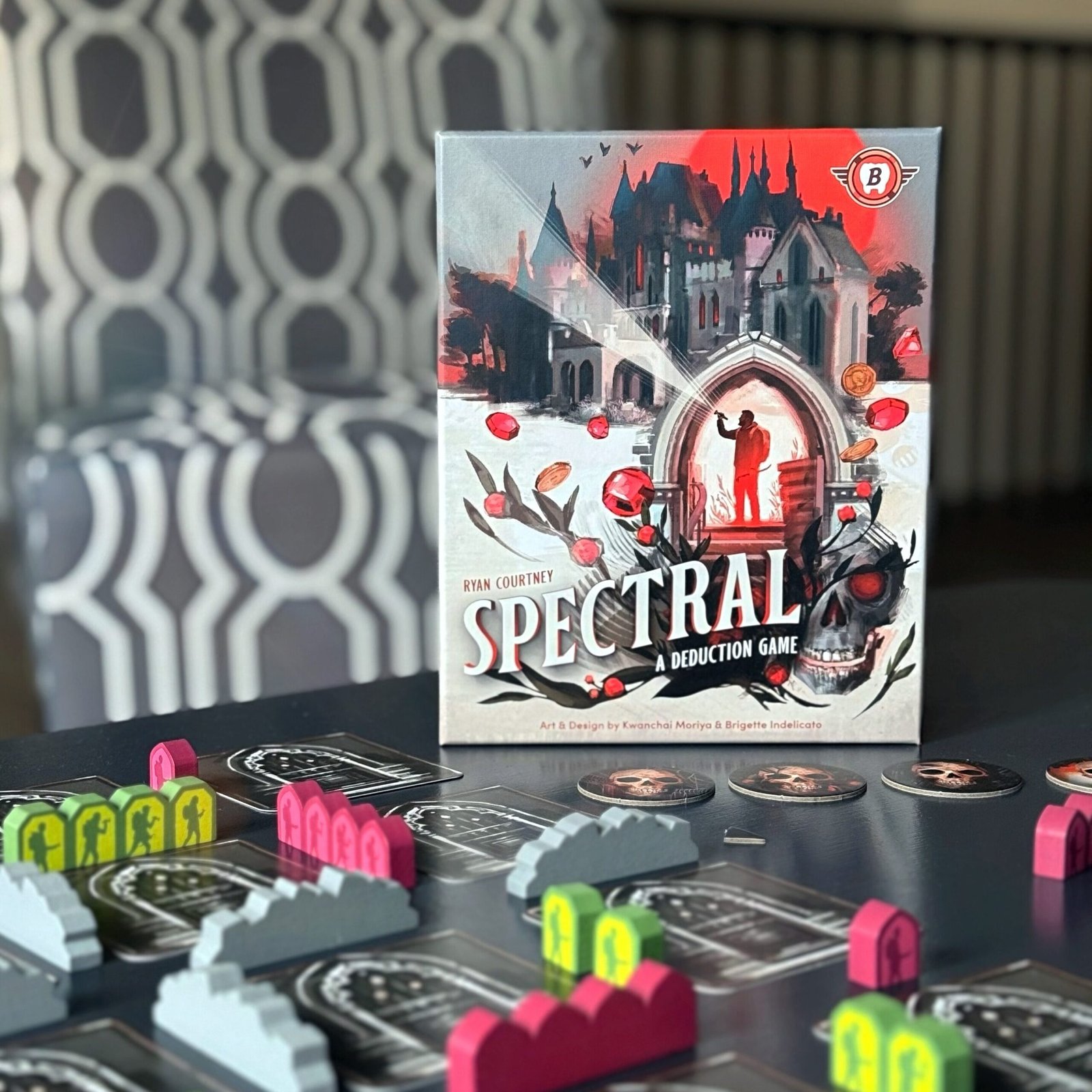
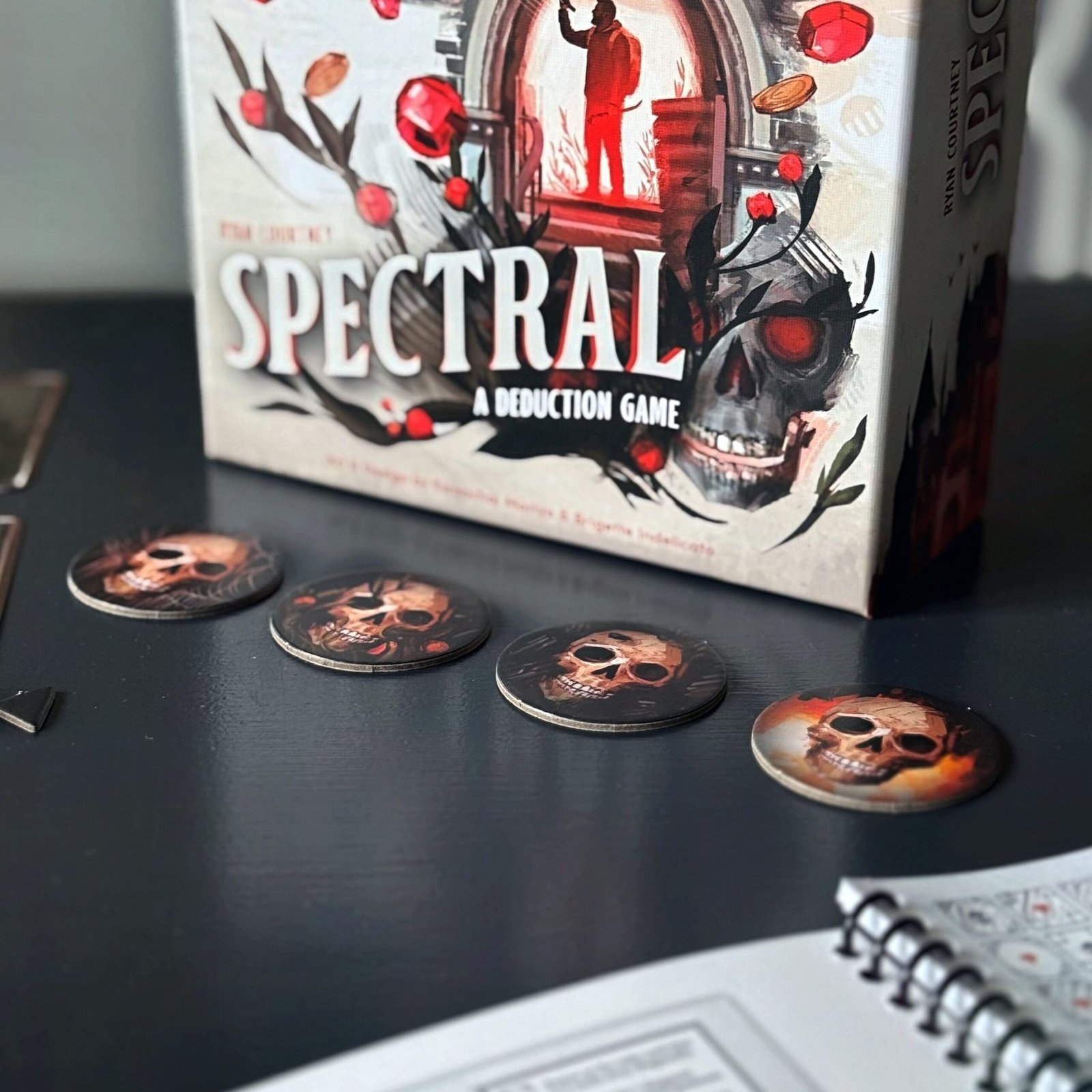
Spectral fits into that world, but it doesn’t stay sealed in the bubble of multiplayer solitaire. Yes, you still hear the room filled with gentle mumbles as players log clues and connect patterns, but it adds something most deduction games don’t: interaction! Halfway through the game, the focus shifts from finding out information to using that information to your advantage through edge-based area majority.
Clues, Cards, and Calculated Guesses
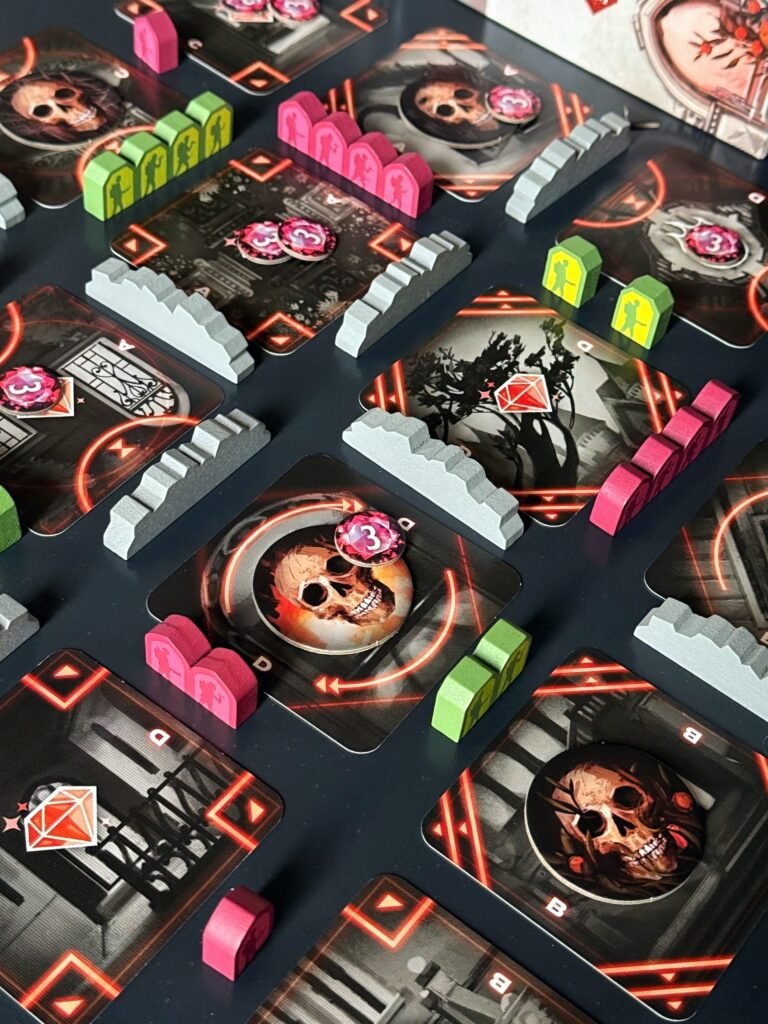
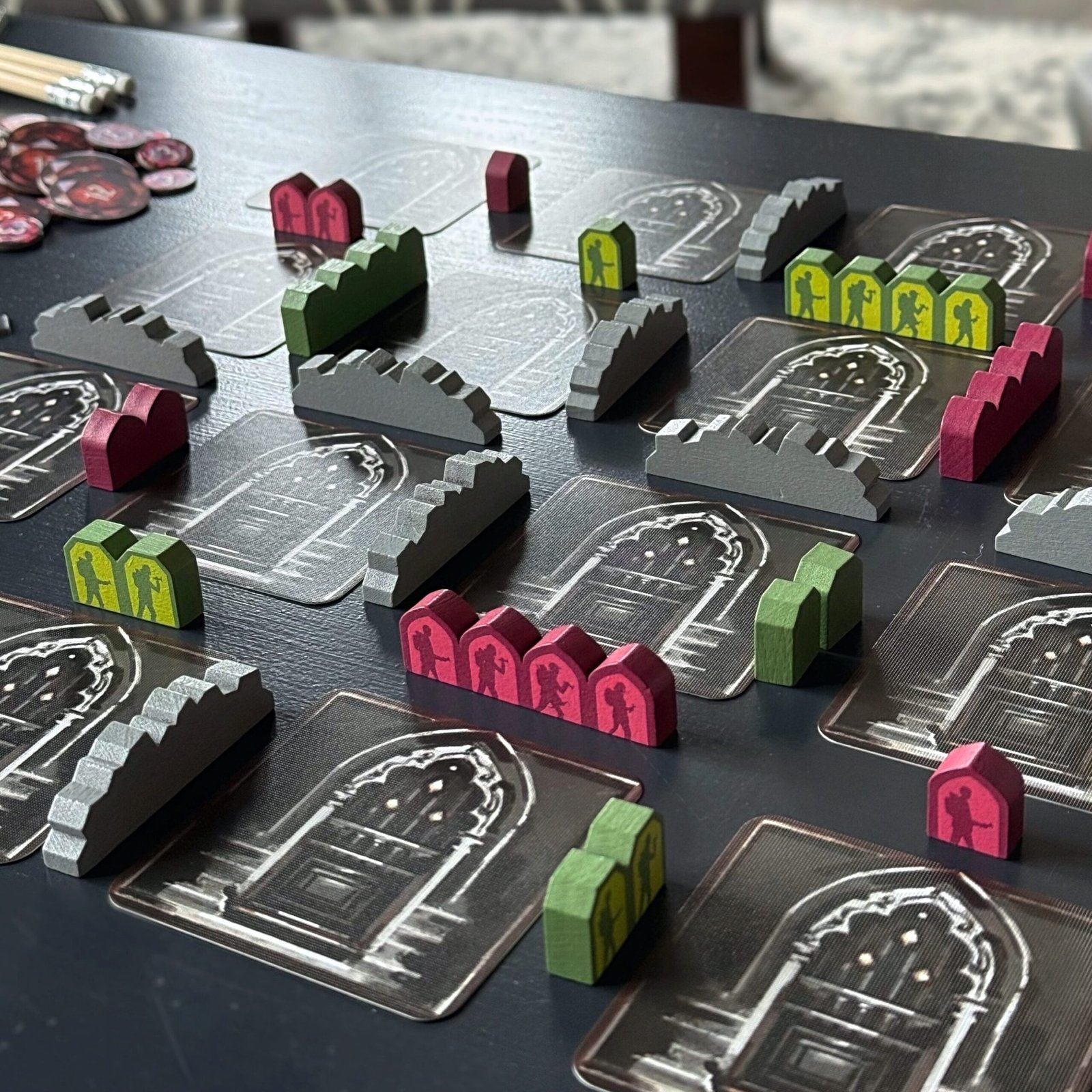
You’ll explore a haunted house made up of face-down cards arranged in a grid, trying to locate gems while avoiding curses. Each turn, place a small explorer token between two rooms and peek at a card’s symbol.
But the symbols aren’t straightforward—they don’t reveal what’s in the card, but what’s around it.
A clue might say there’s a gem two spaces to the left or a curse directly opposite. Every card belongs to a set (A, B, C, or D) and figuring out how those sets align with rows and columns becomes part of the larger deduction puzzle.
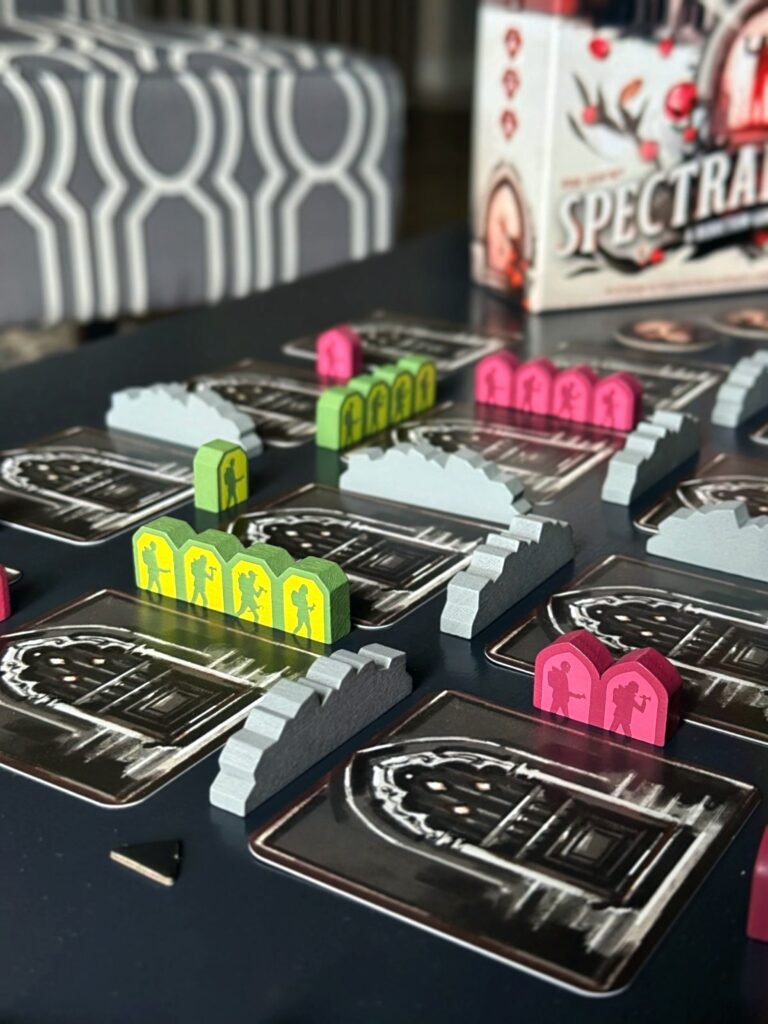
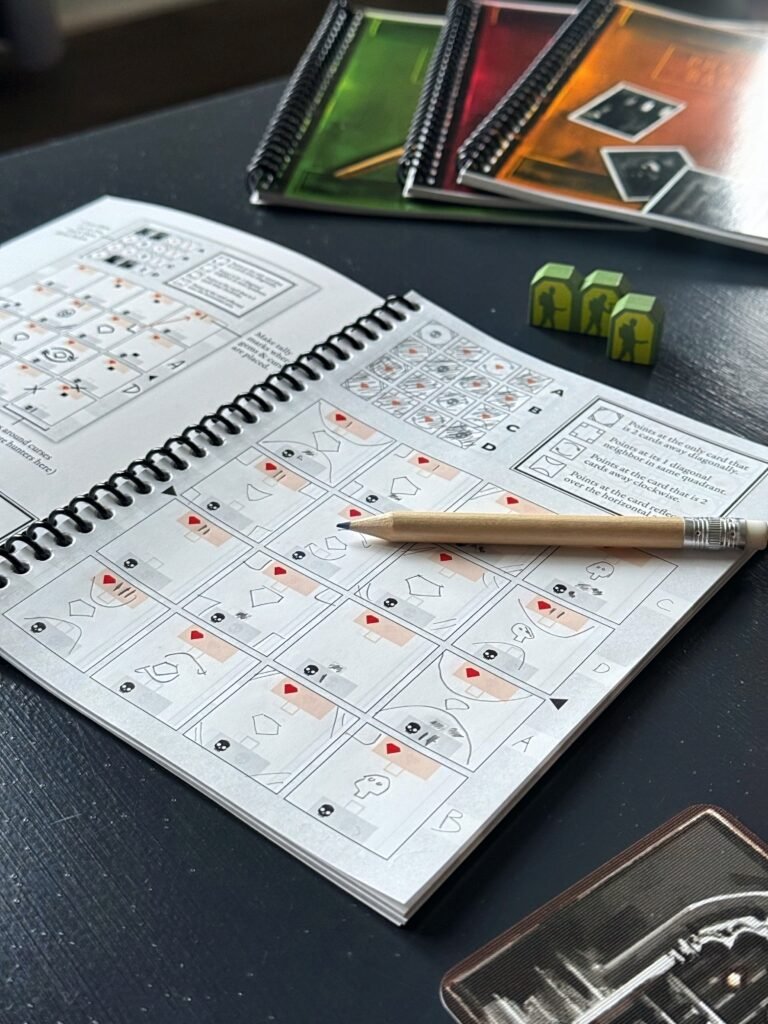
Gradually, patterns emerged. You begin logging information, referencing symbols, and narrowing down possibilities. Eventually, reaching a tipping point, the moment where you stop investigating and start deducing. Not because you’ve uncovered everything, but because your resources are running out. You only have so many explorers. Each token placed is one fewer available for repositioning and scoring.
From Clarity to Competition
And that’s when Spectral shifts.
From a contemplative solo exercise, it becomes a game of positioning. No longer just trying to know where the gems are, but how you can guarantee you’ll benefit from them. Place high-value explorers next to rooms you believe are most rewarding. You’ll bluff, you’ll bait, you’ll calculate whether a 1-token in a suspicious spot will make someone overcommit their 2-token just to challenge you.
This is where Spectral surprises. That quiet deduction muttering turns into a silent social meta. You’re weighing your information against the risks. Second-guessing your opponent’s confidence. Hoping they fall for your feigned certainty or wondering if their nonchalance is bait. Because explorers can be ousted if someone places a token of double the value, there’s room for manipulation and risk.
Risk, Reward, and the Curse of Overconfidence
And it matters. Because when the rooms flip, gems are split among adjacent players, so you want the majority. But curses? Curses wipe everyone adjacent before any points are handed out. So while finding gems is good, identifying curses is essential. A single curse can erase multiple turns of effort. So even if you’re surrounding a room with gems, if the other room adjacent to you has a curse, you won’t benefit.
There’s a tug of war element; more explorers means control of a room’s reward. You can even replace your own pieces to shift control. But do you commit to a spot that might be cursed just to keep your opponents guessing? Do you give up a precious piece to bluff? There’s a compelling balance here between information and instinct.
A Smart Arc in a Tight Package
And all of this unfolds in about 30 minutes. That’s what makes Spectral so smart. There’s a clear rhythm to the arc: a gentle climb through deduction followed by a tense final act of strategic placement and bluffing. It feels almost like a deck-builder that pivots from engine-building to scoring. And when the shift comes, it’s satisfying.
The But…
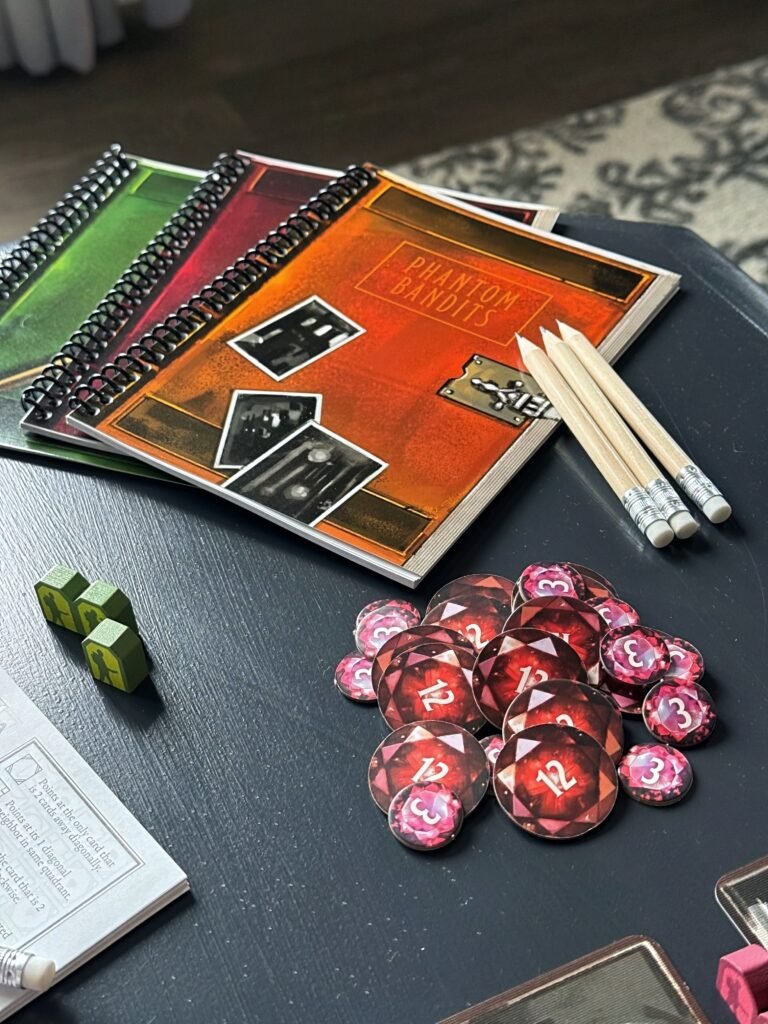
Of course, the game isn’t perfect. The spiral-bound notebooks are functional, but we’d rather have had a dry-erase board with privacy shields.
Spatial reasoning can be a challenge, especially at awkward angles, and early plays can feel like stabs in the dark.
In two-player games, each token is so valuable that one or two bad placements can tilt the game.
Scoring, while functional, is more mathy than climactic. Without full information, it’s hard to know exactly what each move is worth, and while that’s part of the fun, it can also lead to a slightly flat ending.
But the deduction? Delicious! And so is the pressure. Spectral asks you to act before you’re ready. To guess boldly. To watch others guess boldly and wonder if they’re right. It blends logic and tension in a way that few short deduction games manage to pull off.
Some of our favourite moments came when we knew our opponent had committed heavily to a cursed room, and had to decide whether to let them suffer or pretend to fight over it, just to make them second-guess. Do you waste a token just to make them squirm? It might cost you. Or it might be the perfect distraction. And then there’s the matter of leftovers… Any unused explorers become points too.
Primed for an Expansion
We’d love to see an expansion. There’s real room here for clever mitigation, for opportunities to adjust strategy midgame or recover from an unlucky placement. Right now, once an explorer is down, it’s committed unless someone knocks it out of place. And if that choice was a misstep, especially in a two-player game where every explorer is weighted with startling importance, that error sticks.
Imagine if certain rooms gave players a chance to peek again, to swap tokens, or even to manipulate positioning. A bluff becomes more layered when you have tools to reinforce it. Even better: imagine doors that offer a dilemma. Open one for your standard gem vs curse information, but maybe peek into the other to let you know the information in an additional room, shift your or your opponent’s pieces, rotate a room on a board, or maybe there’s nothing behind the door at all! You took a risk, you’ll have to see how it plays out! That kind of chance-based decision would fit beautifully within the game’s current tempo: one of informed uncertainty with just enough chaos to keep things tense. It’s already a clever game, but it’s one that’s practically begging for a few spectral twists.
Another slight tweak we would’ve loved to see during scoring was if the reveal happened in a clever snake-like pattern. It could give even more weight to edge placement; one room might have 3 gems, but you’ll want to be on the side that isn’t also adjacent to a cursed room. Timing would matter. Your explorer could collect points from one room before being eliminated by a curse. Prioritizing when a room will flip is almost as important as what it contains. The logistics of this get muddy when you consider that revealing a room just affects a room somewhere else in the grid. But hey, it’s just an idea.
Room to Grow at the Table
We’ve only played the base two-player game so far, and it’s impressed us, but it also left us curious about the potential depth at higher player counts. Spectral’s rule adjustments for different player counts are smart: when playing with fewer people, some room edges are blocked off entirely. That tightens the board and increases tension, making each placement more deliberate and impactful. With more players, the board breathes a bit, but the competition likely sharpens.
We’ve yet to try the advanced cards, which promise trickier clues and more layered deduction, but even with just the basics, there’s plenty to chew on. We’re eager to see how the game shifts with added minds at the table; how bluffing escalates and deduction evolves when the mental grotto gets just a bit more crowded.
Final Thoughts
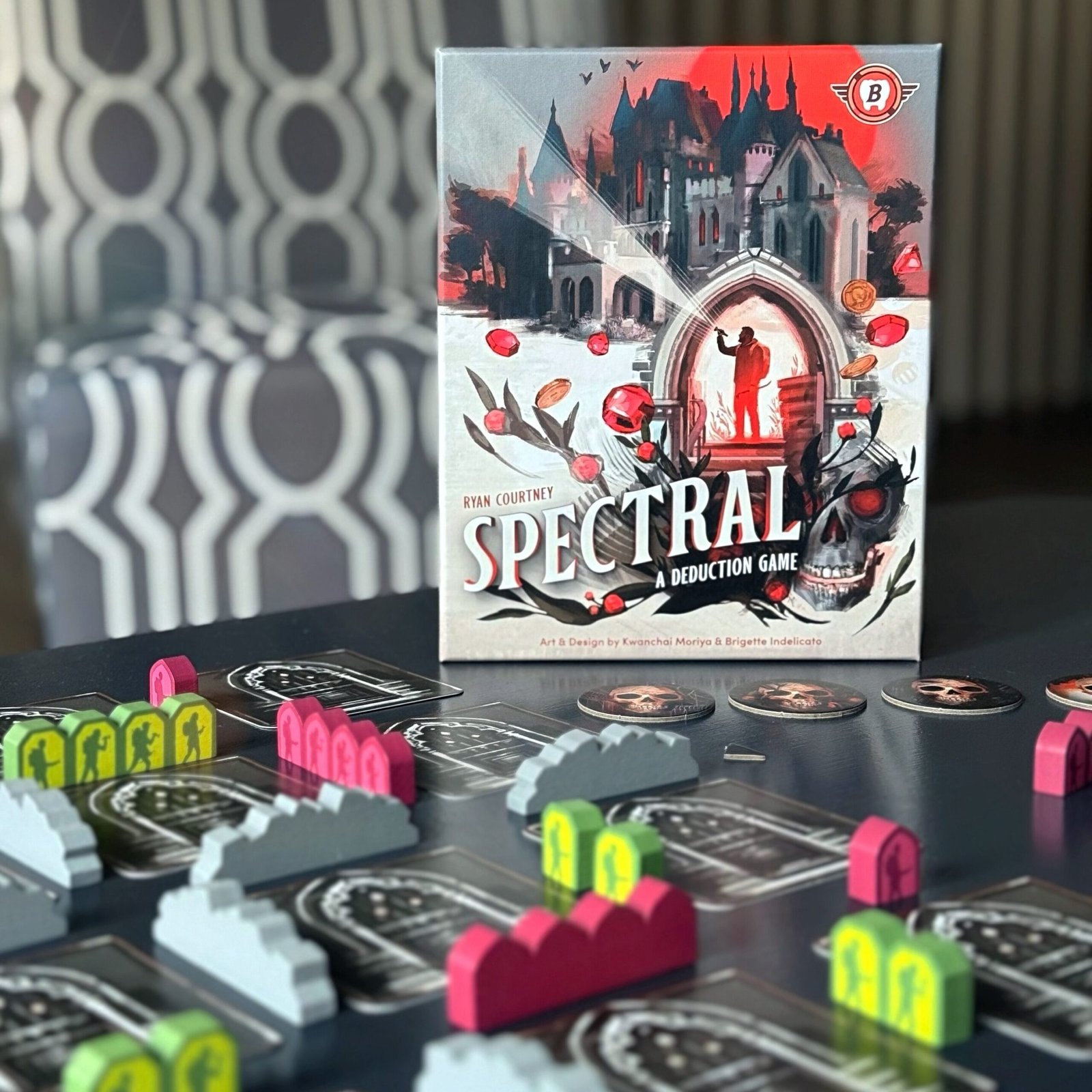
Even without those extras, Spectral is a standout game. Sharp, elegant, and sneaky. It will wrap your brain in cobwebs and keep you puzzling long after the last token is placed. And best of all, you still get to experience the end-game autopsy; a conversation after the fact that’s as gratifying as any win. How did you get that? Why didn’t I see it? The game ends, and the board becomes a blackboard, covered in invisible math and missed connections.
We thoroughly enjoyed our time with this game and are eager to play it more, either just at two or even with more players!
Corinna’s Rating: 8.4
Duncan’s Rating: 7.3